Preferences for designing logos always change, and there is no formula to decide which logo style will be adopted and which will be overlooked. Creating a unique and custom design that is eligible for trademark is crucial for any business. Here’s a few predictions for Logo Design Trends in the upcoming year:

#1 Simple Shapes
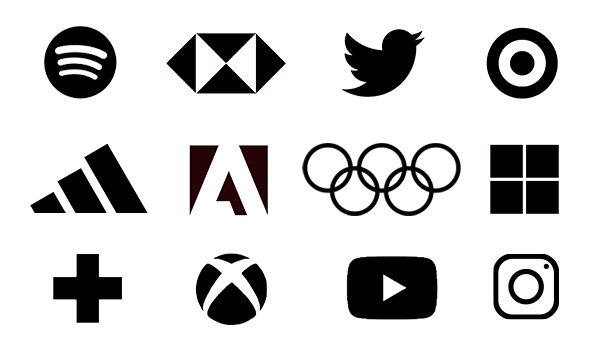
simple shape logo examples

Simple shapes are going to be one of the hottest and top logo design trends in 2022. By following this trend, brands will be able to obtain attractive and simple logo designs that will catch their customers’ attention more easily and pay attention to their brand image. We can also expect that simple shapes will incorporate bright colors to logos to help promote the brands and increase customer interaction.

#2 Minimalism
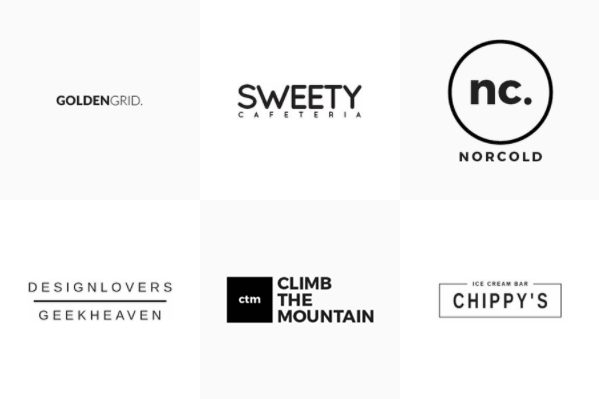
minimalist logo examples

With this strategy, designers usually simplify the image by minimizing the features that are not impactful to the audience. Minimalism not only allows users to access their required information within a shorter period of time, but it also makes user experience simpler. Due to a greater impact not only with the overall aesthetic but also functionality, the minimalist design is predicted to be one of the best logo design trends.

#3 Typography Only
typographic logo examples

More brands are deciding on logos that are purely typography only. This design trend helps brands or websites to immediately wow customers, draw them in, and get them interested to know more about the brand. The main advantage of utilizing typography is that it creates a cohesive image of the brand logo using letters.
While we might be feeling a bit of déjà vu, the world has changed significantly in the last two years. From a business and marketing standpoint, this means more flexibility and adjusting the approach.

The last two years have reinforced what we already know – brands must communicate in very local and precise terms, targeting specific consumers based on their circumstances and what’s relevant to them. This involves understanding their current situation and how it’s changing. Messages need to be personally relevant, aligned to an individual’s situation and values, and create a personal, human connection.

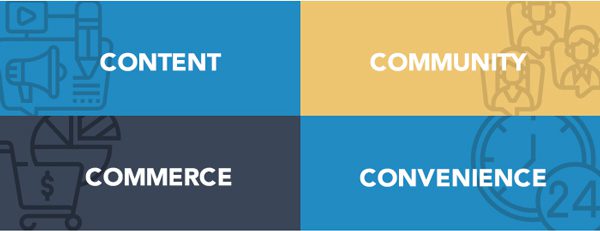
The old adage was that you are competing with your competitors. In today’s day and age, the new truth is that you are competing with the last best experience your customer or client had. Digital transformation has accelerated in the last two years, which sent consumer expectations skyrocketing in terms of what companies could do for them with a more digital experience. Customers also now expect you to have exactly what they want or need, exactly when they need it. Data allows for the creation of more relevant experiences such as:

Content (that can be provided in experiences like emails or mobile apps)

Commerce (such as physical retail, e-commerce, or a hybrid experience)

Community (such as convening B2B buyers at a virtual trade show, hosting a webinar on home repair for consumers, etc)

Convenience (like offering consumers coupons or benefits from a loyalty program)

Your customers/clients must sit at the heart of your customer journey – not just at the heart of your marketing strategy. It’s important to remember that marketing is often just the beginning of a relationship with the customer. For example, the journey starts with engaging them, converting them to a sale directly or indirectly, and then hopefully retaining them so they become advocates and potentially open to upsells and cross-sells. Marketing must be viewed in the context of the full end-to-end journey and, where possible, work to connect the dots.

The last two years have created in irreversible trend to embrace a nimble mentality with marketing. This new mindset is likely a permanent change and includes continuous consumer listening and demand sensing to adjust messaging or supply chain issues quickly. It means faster decision cycles and more flexibility across all areas like creative, budgeting, and media placement.

Embracing these new truths for business and marketing represent the path to both post-pandemic and long-term success. There may be an adjustment period, especially for those accustomed to the ways of the past, but we can find familiarity and confident footing in knowing that the perspective of the customer must be the main priority now and in the future.

When you hear ‘social media’, most people automatically think of Facebook or Instagram. However, those might not always align with your campaign goals or target audience. There are multiple other platforms that offer options to successfully reach your target mix, informing them of your products or services, and turning them into high quality conversions. Let’s look at a few:

  • linkedin

Advertising on LinkedIn provides a way to engage within the professional realm of social media. The major advantage of LinkedIn marketing is that you can reach trustworthy professionals that will drive actions that are relevant to your business and goals. An advantage that LinkedIn has over other forms of traditional social media is that a lot of first-party data is available just through someone’s profile. You can distinguish one’s job, position, what company and how long they’ve been employed, education, previous employers, skills, and who they are connected to. LinkedIn provides a vast number of targeting tactics such as company size, groups of interest, education, location, and geography, and more that can further ensure that your dollars are being spent correctly.

  • pinterest

Pinterest advertising offers brand awareness, conversions, offline sales, and more traffic. Pinterest is used by those who want something new, but don’t have an exact idea in mind. It can be used as a visual search engine – which makes this platform a standout for retail. Pinterest advertising offers the unique feature of those ads are relevant to what the pinners are searching for. Pinterest offers ways to find the perfect target audience for your business or campaign. They allow targets to be split based on demographics (age, gender, location, or language), interests, keywords, customer lists (reaching those who engage with your website, store or previous ads), and ‘actalike’s.’

  • Twitter/X

Twitter has the advantage of offering a lasting impression on those who are served your ads. The reason for this is that people come to Twitter with a discovery mindset. The audience on Twitter is more likely to be passionate, engaged, and open to learning than those on other social media sites. People spend 25% more time viewing ads on Twitter than other leading platforms. Twitter has a vast and detailed process of providing you with the correct audience for your campaign. First, you can pinpoint based on demographics (location, language, platform, device, age, and gender). Then you can split those groups into targeting based on event, tweet engager, keyword, movies, tv, interest, conversation, and more.

So, what’s in the forecast? While the last 18 months have taught us all that flexibility is key, here’s a look at what is expected in 2022:

57% of business owners surveyed think it’s harder to sustain a business now than it was six months ago

Borrell Associates surveys small-to-medium sized business owners throughout the year. In their most recent survey from August 2021, 57% of business owners surveyed think it’s harder to sustain a business now than it was six months ago. 23% think there’s been no change, and 18% believe it’s easier now (the remaining 2% had no opinion). When it comes to economic conditions, the majority of business owners (57%) think that economic conditions will either stay the same or get better over the next six months. As a result of that, most of those surveyed (77%) anticipate spending the same or more on advertising.

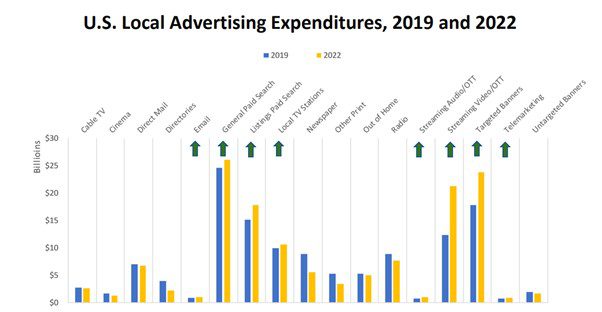
Local advertising expenditures are projected to increase by 6.4% overall. The bulk of the change is expected to come from streaming audio/radio and video. Spending for yellow page directories, newspapers, and other print is expected to decrease. Due to the unprecedented nature of 2020 (and at least part of 2021), 2019 was used as a base year for these projections, since that was the last ‘normal’ year.

In the long view of local advertising expenditures, digital has far surpassed other media over the last 10 years. From 2019 to 2020, digital share jumped by 6% (up to 63% in 2020 compared to 57% in 2019). 2022 is projected to be at 67%. Two-thirds of every advertising dollar spent by businesses is spent on digital. Paid search, social media and video account for 75% of all digital advertising, and spending on online video is expected to surpass search in 2025. The new year provides new opportunities to refresh your marketing. Take time to regularly review what’s working and what may not be. Think about new strategies you can try and existing strategies you can refine to be successful. We’re happy to help you plan not just for 2022, but for the years to come!

Here are some of the top trends impacting your brand:

the race to roi

As businesses struggle to recoup lost sales in the wake of the pandemic, marketers turn to social to meet two equally urgent imperatives: deliver short-term ROI with targeted performance marketing tactics while building innovative digital experiences that win long-term loyalty by bringing discovery, connection, and fun back to the customer experience.

silence is golden

A dramatic uptick in social media use presented a huge number of new opportunities for brands this year–but many missed the mark by jumping in too soon. Smart brands sat back and listened, then won with creative, original ways of fitting into the social conversation to break through the wall of indifference.

way more than ok

Stereotypes, ageism, and a yearslong habit of chasing newness over effectiveness have left marketers underestimating an increasingly digitally savvy and lucrative demographic: baby boomers. By using smart segmentation and thoughtful representation, marketers that include baby boomers in their digital strategies can leapfrog those still stuck in stereotypes.

do i know you?

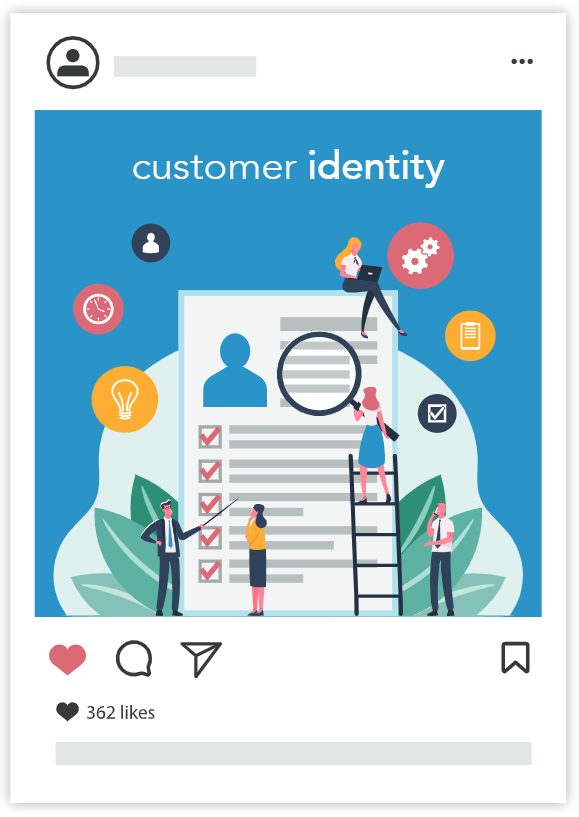
For years, linking social media engagement to customer identity has proved an elusive goal for marketers. But with renewed momentum and executive attention on social media’s ability to retain critical connections with customers, now is the time to take steps–big or small–to bridging the critical gap between engagement and customer identity.

If you’re like most of us, you’re barreling into the end of the year, budgets ablazing, hell bent on reaching your financial goals by the end of the fiscal year.

It’s an intense time, you’re tweaking campaigns, optimizing performance, maybe even throwing a few Hail Marys. It’s easy during this time to be so focused on finishing THIS year strong that we forget to set aside time to plan for the future. We all know successful strategic planning takes focused time and a clear head. But how do you build that into your already hectic fourth quarter day?

Here’s how to win the planning game….

play #1: use your calendar to block time

Think about the time of day when you are most focused and make an appointment with yourself to work in 30-minute uninterrupted blocks. Half an hour doesn’t seem like much, but when you’ve closed all the open windows on your laptop (yes, even email and social media), turned off notifications and are fully tuned into the task at hand, you’ll be surprised at what you can accomplish.

play #2: prepare the stats

Make a list of all of the data you need to inform your planning before you get to work. Nothing slows down a productive work session like not having the facts and figures you need at your fingertips. Pull the numbers you need ahead of time and you’ll have fewer excuses to call a time-out once you get started.

play #3: not every play ends with a touchdown

For many of us, the biggest obstacle to starting is not wanting to put anything less than perfect on paper. Think of your plans as draft documents that will be updated and tweaked as you go. Start somewhere, anywhere, it doesn’t even have to be at the beginning. Once you begin to see the framework coming to life, it’ll get easier and easier to flush out the details.

play #4: call an audible

If you get stuck, we’re here and we’ve got the ideas! Sometimes all you need is someone to help you evaluate your playbook. Other times you need someone to help you brainstorm the entire formation. CSM is here for either or both.

See you in the end zone!

So you just started a new digital ad campaign – paid search, display, or video – and you’re understandably excited! But then you notice that you’re not seeing your ad. Is something wrong with your campaign? Probably not. It’s not unusual to not see your own ad, for a number of reasons. Let’s take a look at why this might be happening.

paid search

Your paid search campaign started and you keep searching for your business name or industry keywords, and your ad isn’t appearing. Why? Search engines are designed with in-depth, algorithm-based rules and preferences to determine intent and what ads to serve – and those algorithms undergo some amount of change almost every day! Since paid search is an auction system with real-time bids, a search that happens now will show different results than a search that happens five minutes from now.

There are many factors that will affect whether an ad will show such as day of the week, time, device type, bid, competitor bid, etc.

If you’ve previously searched and your URL has come up organically and you did not click it, or clicked it and closed quickly, the search engines think that you’re not interested in that site so they won’t show it to you in a paid ad. Searching repeatedly and not clicking on any ads or links will actually lessen the chances of seeing your ad, since the search engines think that you’re not interested in the types of ads they’ve been serving.

Additionally, if you do see your ad after searching on it, clicking on it will cost you money (since it’s a pay per click product). If you leave your site right after clicking the ad, the search engines will think your ad is less relevant, which negatively impacts your campaign’s performance. However, seeing your ad and not clicking it also hurts the campaign, because it thinks your ad is less relevant. As tempting as it is, it’s best to refrain trying to find yourself on paid search.

display and/or digital video

The main reason why you may not see your display or video ad is the size of the Real Time Bidding environment. Our ads and videos run across 20+ ad exchanges – that’s thousands of sites and streaming platforms. Think of it like running TV commercials on every single channel at random times throughout the day. Grab a remote and start channel-surfing, and it’s still unlikely to find your ad, even though we know that it is running.

Many of our campaigns use layered targeting to serve your ads to the right audience. Maybe your profile falls outside that target demographic, or you’re not considered in-market for a product or service because you haven’t shown a historical interest in it.

There are many qualifiers and factors that go into whether you see your ad or not, so not seeing an ad is not an indicator that something is wrong with your campaign.

Brand safety has always been a concern in digital marketing, and businesses are more aware than ever about ensuring their ads are served beside appropriate content and being seen by actual people – not bots. We utilize several tools to ensure that your ads are placed alongside quality content and seen by humans.

implement preemptive strategies

We implement preemptive strategies which can maximize brand safety for any business. Sites that are deemed unsafe for brands, that have signs of fraudulent traffic, or provide otherwise controversial content are added to a global blocklist so none of your ads are seen on those domains. Our website crawlers spend 24 hours a day, 365 days a year reading sites to determine the content and keywords on the page so your ads will only be served on appropriate pages. Since new content is being created all the time, this system updates in near real-time to quickly classify the content.

Protect your Campaigns

We protect your campaigns against bots by using both IAB (Interactive Advertising Bureau) and OTA (Online Trust Alliance) Bot Lists during campaign setup – these sources identify and publish discovered bots and ad fraud traffic. We also use RiskIQ to detect malware and non-human traffic, as well as Comscore to remove botnets, click farms, pay-per-view networks, and nonhuman traffic. If bot traffic does somehow get through, that data is ‘scrubbed’ (removed) from your campaign dashboard and reporting, so the results you see are for actual human traffic.

So what exactly is native? It’s paid content – articles, images, infographics, etc – that align with the tone and style of the publication or site its posted on. Essentially, it blends in with the organic content around it.

81% of consumers trust content on publisher sites

Three out of four publishers offer some form of native advertising on their websites, and 41% of brands are currently using native advertising. Native ads can be interesting, informative, and promote a product or brand. The key is that it is non-disruptive – it exposes the reader to advertising content without sticking out.

Why are brands increasingly turning to native? It’s effective – 81% of consumers trust content on publisher sites, and native ads create an 18% increase in intent. Native also fights ad fatigue, which happens when the audience gets bored with seeing ads. Native provides brand exposure cloaked in editorial content, so they don’t tire out the audience. As long as the content is relevant and interesting, native advertising engages the audience.

see it in action

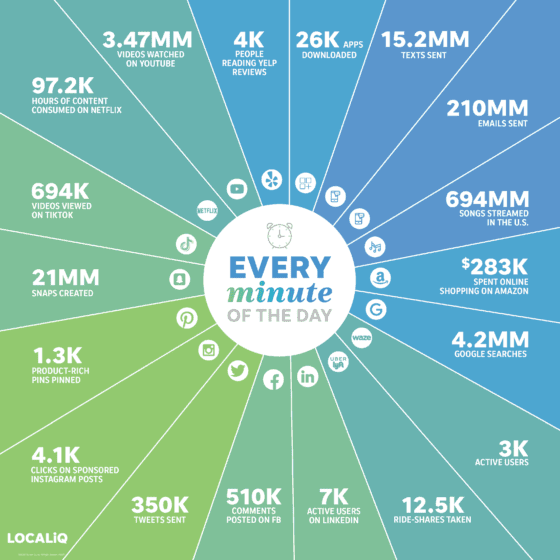
Lots of things can happen in one minute. Your heart will beat 60 – 100 times. Your eyes will blink 15 – 20 times. 210 million emails will be sent. 510,000 comments will be posted on Facebook.

In the last year, the time consumers have spent online has only increased. Online content consumption nearly doubled in 2020, compared to 2019!

Taking a look at what happens in just one minute on the Internet tells us it’s important to get in front of today’s busy – and distracted – consumers!

here’s just a few of our favorite digital statistics!

  • google

2 million searches happen on Google every minute!

46% of those searches have local intent, and 81% of users searched online for a product or service specifically to make a purchase.

  • streaming services

Streaming video services account for nearly 20% of TV viewing in the U.S.

People spent an average of over one hour on streaming services each day in 2020 (2x higher than 2019!)

  • tiktok

TikTok was the second-most downloaded app in 2020.

They have the highest engagement rate per post across social media sites.

  • snapchat

Snapchat is the second-most visited social platform in the U.S.

Users are more likely to make purchases from their mobile device than non-Snapchat users.

  • facebook

Facebook users click an average of 12 ads every month.

Users spend an average of 34 minutes every day on the site/app!

  • youtube

70% of people made a purchase from a business after seeing them on YouTube.

90% say they find new brands or businesses.

  • twitter

350,000 Tweets are sent every minute on Twitter.

Video views increased 62% from 2019 to 2020!

  • instagram

The average user spends 30 minutes per day on Instagram.

81% of users use Instagram to research products and services.

  • linkedin

40% of LinkedIn users visit the site every day.

It’s the most trusted social network in the U.S.

  • emails

6 billion emails are sent and received every day.