When you hear ‘social media’, most people automatically think of Facebook or Instagram. However, those might not always align with your campaign goals or target audience. There are multiple other platforms that offer options to successfully reach your target mix, informing them of your products or services, and turning them into high quality conversions. Let’s look at a few:

  • linkedin

Advertising on LinkedIn provides a way to engage within the professional realm of social media. The major advantage of LinkedIn marketing is that you can reach trustworthy professionals that will drive actions that are relevant to your business and goals. An advantage that LinkedIn has over other forms of traditional social media is that a lot of first-party data is available just through someone’s profile. You can distinguish one’s job, position, what company and how long they’ve been employed, education, previous employers, skills, and who they are connected to. LinkedIn provides a vast number of targeting tactics such as company size, groups of interest, education, location, and geography, and more that can further ensure that your dollars are being spent correctly.

  • pinterest

Pinterest advertising offers brand awareness, conversions, offline sales, and more traffic. Pinterest is used by those who want something new, but don’t have an exact idea in mind. It can be used as a visual search engine – which makes this platform a standout for retail. Pinterest advertising offers the unique feature of those ads are relevant to what the pinners are searching for. Pinterest offers ways to find the perfect target audience for your business or campaign. They allow targets to be split based on demographics (age, gender, location, or language), interests, keywords, customer lists (reaching those who engage with your website, store or previous ads), and ‘actalike’s.’

  • Twitter/X

Twitter has the advantage of offering a lasting impression on those who are served your ads. The reason for this is that people come to Twitter with a discovery mindset. The audience on Twitter is more likely to be passionate, engaged, and open to learning than those on other social media sites. People spend 25% more time viewing ads on Twitter than other leading platforms. Twitter has a vast and detailed process of providing you with the correct audience for your campaign. First, you can pinpoint based on demographics (location, language, platform, device, age, and gender). Then you can split those groups into targeting based on event, tweet engager, keyword, movies, tv, interest, conversation, and more.
So, what’s in the forecast? While the last 18 months have taught us all that flexibility is key, here’s a look at what is expected in 2022:

57% of business owners surveyed think it’s harder to sustain a business now than it was six months ago

Borrell Associates surveys small-to-medium sized business owners throughout the year. In their most recent survey from August 2021, 57% of business owners surveyed think it’s harder to sustain a business now than it was six months ago. 23% think there’s been no change, and 18% believe it’s easier now (the remaining 2% had no opinion). When it comes to economic conditions, the majority of business owners (57%) think that economic conditions will either stay the same or get better over the next six months. As a result of that, most of those surveyed (77%) anticipate spending the same or more on advertising.

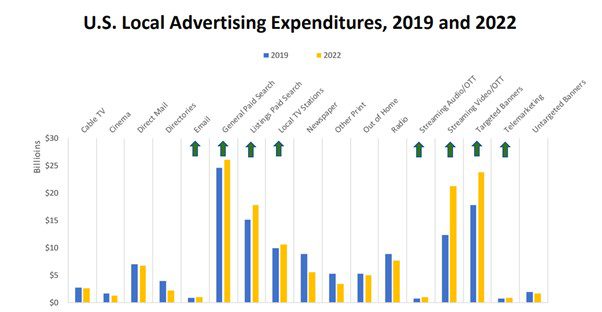
Local advertising expenditures are projected to increase by 6.4% overall. The bulk of the change is expected to come from streaming audio/radio and video. Spending for yellow page directories, newspapers, and other print is expected to decrease. Due to the unprecedented nature of 2020 (and at least part of 2021), 2019 was used as a base year for these projections, since that was the last ‘normal’ year.

In the long view of local advertising expenditures, digital has far surpassed other media over the last 10 years. From 2019 to 2020, digital share jumped by 6% (up to 63% in 2020 compared to 57% in 2019). 2022 is projected to be at 67%. Two-thirds of every advertising dollar spent by businesses is spent on digital. Paid search, social media and video account for 75% of all digital advertising, and spending on online video is expected to surpass search in 2025. The new year provides new opportunities to refresh your marketing. Take time to regularly review what’s working and what may not be. Think about new strategies you can try and existing strategies you can refine to be successful. We’re happy to help you plan not just for 2022, but for the years to come!

Here are some of the top trends impacting your brand:

the race to roi

As businesses struggle to recoup lost sales in the wake of the pandemic, marketers turn to social to meet two equally urgent imperatives: deliver short-term ROI with targeted performance marketing tactics while building innovative digital experiences that win long-term loyalty by bringing discovery, connection, and fun back to the customer experience.

silence is golden

A dramatic uptick in social media use presented a huge number of new opportunities for brands this year–but many missed the mark by jumping in too soon. Smart brands sat back and listened, then won with creative, original ways of fitting into the social conversation to break through the wall of indifference.

way more than ok

Stereotypes, ageism, and a yearslong habit of chasing newness over effectiveness have left marketers underestimating an increasingly digitally savvy and lucrative demographic: baby boomers. By using smart segmentation and thoughtful representation, marketers that include baby boomers in their digital strategies can leapfrog those still stuck in stereotypes.

do i know you?

For years, linking social media engagement to customer identity has proved an elusive goal for marketers. But with renewed momentum and executive attention on social media’s ability to retain critical connections with customers, now is the time to take steps–big or small–to bridging the critical gap between engagement and customer identity.

If you’re like most of us, you’re barreling into the end of the year, budgets ablazing, hell bent on reaching your financial goals by the end of the fiscal year.

It’s an intense time, you’re tweaking campaigns, optimizing performance, maybe even throwing a few Hail Marys. It’s easy during this time to be so focused on finishing THIS year strong that we forget to set aside time to plan for the future. We all know successful strategic planning takes focused time and a clear head. But how do you build that into your already hectic fourth quarter day?

Here’s how to win the planning game….

play #1: use your calendar to block time

Think about the time of day when you are most focused and make an appointment with yourself to work in 30-minute uninterrupted blocks. Half an hour doesn’t seem like much, but when you’ve closed all the open windows on your laptop (yes, even email and social media), turned off notifications and are fully tuned into the task at hand, you’ll be surprised at what you can accomplish.

play #2: prepare the stats

Make a list of all of the data you need to inform your planning before you get to work. Nothing slows down a productive work session like not having the facts and figures you need at your fingertips. Pull the numbers you need ahead of time and you’ll have fewer excuses to call a time-out once you get started.

play #3: not every play ends with a touchdown

For many of us, the biggest obstacle to starting is not wanting to put anything less than perfect on paper. Think of your plans as draft documents that will be updated and tweaked as you go. Start somewhere, anywhere, it doesn’t even have to be at the beginning. Once you begin to see the framework coming to life, it’ll get easier and easier to flush out the details.

play #4: call an audible

If you get stuck, we’re here and we’ve got the ideas! Sometimes all you need is someone to help you evaluate your playbook. Other times you need someone to help you brainstorm the entire formation. CSM is here for either or both.

See you in the end zone!

So you just started a new digital ad campaign – paid search, display, or video – and you’re understandably excited! But then you notice that you’re not seeing your ad. Is something wrong with your campaign? Probably not. It’s not unusual to not see your own ad, for a number of reasons. Let’s take a look at why this might be happening.

paid search

Your paid search campaign started and you keep searching for your business name or industry keywords, and your ad isn’t appearing. Why? Search engines are designed with in-depth, algorithm-based rules and preferences to determine intent and what ads to serve – and those algorithms undergo some amount of change almost every day! Since paid search is an auction system with real-time bids, a search that happens now will show different results than a search that happens five minutes from now.

There are many factors that will affect whether an ad will show such as day of the week, time, device type, bid, competitor bid, etc.

If you’ve previously searched and your URL has come up organically and you did not click it, or clicked it and closed quickly, the search engines think that you’re not interested in that site so they won’t show it to you in a paid ad. Searching repeatedly and not clicking on any ads or links will actually lessen the chances of seeing your ad, since the search engines think that you’re not interested in the types of ads they’ve been serving.

Additionally, if you do see your ad after searching on it, clicking on it will cost you money (since it’s a pay per click product). If you leave your site right after clicking the ad, the search engines will think your ad is less relevant, which negatively impacts your campaign’s performance. However, seeing your ad and not clicking it also hurts the campaign, because it thinks your ad is less relevant. As tempting as it is, it’s best to refrain trying to find yourself on paid search.

display and/or digital video

The main reason why you may not see your display or video ad is the size of the Real Time Bidding environment. Our ads and videos run across 20+ ad exchanges – that’s thousands of sites and streaming platforms. Think of it like running TV commercials on every single channel at random times throughout the day. Grab a remote and start channel-surfing, and it’s still unlikely to find your ad, even though we know that it is running.

Many of our campaigns use layered targeting to serve your ads to the right audience. Maybe your profile falls outside that target demographic, or you’re not considered in-market for a product or service because you haven’t shown a historical interest in it.

There are many qualifiers and factors that go into whether you see your ad or not, so not seeing an ad is not an indicator that something is wrong with your campaign.

Brand safety has always been a concern in digital marketing, and businesses are more aware than ever about ensuring their ads are served beside appropriate content and being seen by actual people – not bots. We utilize several tools to ensure that your ads are placed alongside quality content and seen by humans.

implement preemptive strategies

We implement preemptive strategies which can maximize brand safety for any business. Sites that are deemed unsafe for brands, that have signs of fraudulent traffic, or provide otherwise controversial content are added to a global blocklist so none of your ads are seen on those domains. Our website crawlers spend 24 hours a day, 365 days a year reading sites to determine the content and keywords on the page so your ads will only be served on appropriate pages. Since new content is being created all the time, this system updates in near real-time to quickly classify the content.

Protect your Campaigns

We protect your campaigns against bots by using both IAB (Interactive Advertising Bureau) and OTA (Online Trust Alliance) Bot Lists during campaign setup – these sources identify and publish discovered bots and ad fraud traffic. We also use RiskIQ to detect malware and non-human traffic, as well as Comscore to remove botnets, click farms, pay-per-view networks, and nonhuman traffic. If bot traffic does somehow get through, that data is ‘scrubbed’ (removed) from your campaign dashboard and reporting, so the results you see are for actual human traffic.

So what exactly is native? It’s paid content – articles, images, infographics, etc – that align with the tone and style of the publication or site its posted on. Essentially, it blends in with the organic content around it.

81% of consumers trust content on publisher sites

Three out of four publishers offer some form of native advertising on their websites, and 41% of brands are currently using native advertising. Native ads can be interesting, informative, and promote a product or brand. The key is that it is non-disruptive – it exposes the reader to advertising content without sticking out.

Why are brands increasingly turning to native? It’s effective – 81% of consumers trust content on publisher sites, and native ads create an 18% increase in intent. Native also fights ad fatigue, which happens when the audience gets bored with seeing ads. Native provides brand exposure cloaked in editorial content, so they don’t tire out the audience. As long as the content is relevant and interesting, native advertising engages the audience.

see it in action

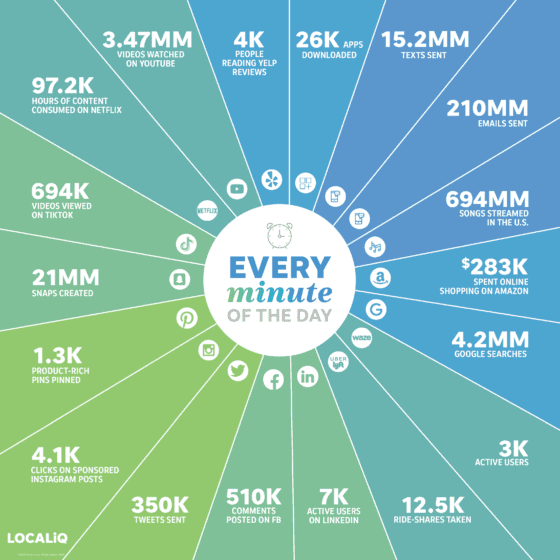
Lots of things can happen in one minute. Your heart will beat 60 – 100 times. Your eyes will blink 15 – 20 times. 210 million emails will be sent. 510,000 comments will be posted on Facebook.

In the last year, the time consumers have spent online has only increased. Online content consumption nearly doubled in 2020, compared to 2019!

Taking a look at what happens in just one minute on the Internet tells us it’s important to get in front of today’s busy – and distracted – consumers!

here’s just a few of our favorite digital statistics!

  • google

2 million searches happen on Google every minute!

46% of those searches have local intent, and 81% of users searched online for a product or service specifically to make a purchase.

  • streaming services

Streaming video services account for nearly 20% of TV viewing in the U.S.

People spent an average of over one hour on streaming services each day in 2020 (2x higher than 2019!)

  • tiktok

TikTok was the second-most downloaded app in 2020.

They have the highest engagement rate per post across social media sites.

  • snapchat

Snapchat is the second-most visited social platform in the U.S.

Users are more likely to make purchases from their mobile device than non-Snapchat users.

  • facebook

Facebook users click an average of 12 ads every month.

Users spend an average of 34 minutes every day on the site/app!

  • youtube

70% of people made a purchase from a business after seeing them on YouTube.

90% say they find new brands or businesses.

  • twitter

350,000 Tweets are sent every minute on Twitter.

Video views increased 62% from 2019 to 2020!

  • instagram

The average user spends 30 minutes per day on Instagram.

81% of users use Instagram to research products and services.

  • linkedin

40% of LinkedIn users visit the site every day.

It’s the most trusted social network in the U.S.

  • emails

6 billion emails are sent and received every day.

By now, you’ve likely heard at least rumblings about updates to Google Cookies, and probably heard about Facebook updates on iOS, as well. While these two sets of updates aren’t related, they are rolling out at around the same time. So just what are these changes, and what do they mean?

google cookies

Last year, Google announced that they would be phasing out third-party cookies by 2022, but first-party cookies are not affected. (First-party cookies are created and stored by the website you are visiting directly, while third-party cookies are created and placed by third-parties other than the direct website).

When Google made this announcement, there was speculation that they might be developing new technologies as ‘workarounds’ for things those cookies were currently being used for. Google has now firmly stated that they will not be replacing third-party cookies with something equally invasive – this is the part that has been in the news recently.

While some of our campaigns and digital tactics use first-party data, none of them use third-party data. Therefore, our campaigns and tactics will be unaffected by this change.

facebook and ios updates

Apple has announced new changes to their privacy settings with their new operating system, iOS14. The App Tracking Transparency framework will now require apps in the App Store that engage in “tracking”, to show a prompt to users to allow them to choose whether they wish to be tracked by that app or not. This new policy will prohibit data collection unless a user opts into tracking.

As more users opt-out of tracking, personalized ads and performance reporting will be limited. These changes to iOS14 will impact data collected from tools such as the Facebook pixel. The information collected can be used for various things such as retargeting website users and view the journeys of website visitors. Traffic ads that optimize for certain pixel events such as landing page views, will be affected by iOS14.

The App Tracking Transparency framework has yet to be fully implemented and the effects of this policy on Facebook ads are constantly changing. We will not fully know the effects of iOS14 on our ads until the policy is in full effect.

Millennials make up 22% of the U.S. population. That makes them the largest generation in the country’s history. Now that millennials are between the ages of 22 and 36, it’s essential to understand their spending habits. 60% of millennials stay loyal to the brands they love. By focusing on the millennial age group, you can build a loyal fan base for your business.

You’ll need to learn the secrets of marketing to millennials first. Here’s some tips to reach the largest living generation of shoppers.

Millennials want to forge a connection with brands. Content marketing can help you build brand trust and ensure you reach your target audience. It’s important to understand your audience as much as possible. Millennials want to engage with brands that feel real and authentic. Content marketing can help forge an emotional connection with your buyers.

Post content on your website, blog, or social media accounts. Try to create unique, informative content that demonstrates your industry expertise and shows off your brand’s personality. Don’t focus on selling your products. Instead, show readers the value you have to offer. Let your experience and expertise shine through. Forging this authentic connection with your audience will help you attract them to your brand in the future.

Complete a thorough business assessment and determine your marketing objectives. Why should customers trust you? What do you have to offer that no one else can?

Focusing on your brand value can give your customers a reason to trust you. Building brand trust will help you retain customers, turning them into loyal fans.

One way to do this is to rely on your existing, happy customers. Ask them to post their happy reviews on your Google My Business listing or website. These reviews will act as social proof, which can help future customers trust you.

This generation has all the information they need at their fingertips. To cut through the noise, you need to remain transparent and authentic. Customer reviews will help you show prospects the benefits of choosing your business. Meanwhile, behind the scenes content can give them an authentic look into how you run your business.

Make sure you’re staying social! Post your website content on social media to keep your customers engaged. Make sure the content you post is high-quality and share-worthy.

When your audience shares your content, you have the chance to reach an even broader range of customers. You can also use social media to start two-way conversations. Make sure to respond to comments or messages quickly. That way, you’re showing your target audience that you’re there and eager to help. If your customers have problems or complaints, don’t ignore them. Otherwise, it could speak negatively about your brand.

A full 84% of millennials say user-generated content has some influence on what they buy. If you want to reach millennial buyers, try using user-generated content. By helping you build brand trust, this content will help customers connect with your brand. They’ll see happy consumers like themselves and recognize you’re someone they can trust.

Remain relevant to your audience of younger consumers! By marketing to millennials, you can grow your business and retain long-lasting business.